PRESENCE - Volume 66
Inspiration For Guitarists
One of the easiest ways to increase your soloing vocabulary is to stop using the pentatonic scale.
Sit with that for a second. I spend a lot of time teaching the pentatonic scale. I talk about how it's the foundation of most guitar solos, and that's not just my opinion — it's the general consensus. So why would I tell you to stop using it?
Because there's one note you're probably leaving out. And most players walk right past it.
Adding the flat 5 to your minor pentatonic — or the flat 3 to your major pentatonic — turns it into the Blues Scale. One note. That's all that stands between the scale you already know and a whole new layer of vocabulary.
Here's the part most people don't think about: that additional note creates three-note groupings on a single string. This might sound like a small thing, but it isn't. Two notes per string is what gives the pentatonic its clean, predictable patterns — which is exactly why it's the right place to start. But those same patterns can become a cage. Three notes on one string breaks you out. It opens up new melodic shapes, and it actually makes certain runs easier to play — flowing across a single string is smoother than the constant string-crossing the pentatonic demands.
The other thing about the blues scale: you can add that note any time, no theory required. There is never a situation where the pentatonic works but the blues scale note doesn't. It might give your lines a bluesier inflection, which won't fit every song — but it's always available.
Think about Stevie Ray Vaughan soloing over "Let It Be." That's a gorgeous, almost hymn-like song. A lot of players would reach for the major pentatonic and stay there. But Stevie Ray was so soaked in blues that I don't think he could have helped himself — that blues note would have been in there. It was just part of the sound he heard in his head.
You want that note to become part of the sound you hear in your head.
Here's the kicker on the theory side: whether you're treating a shape as a major pentatonic or a minor pentatonic, that blues scale note lands in the same physical location on the neck. Your hand doesn't need to know which key you're in. It just works.
Below are the two landmark shapes of the A minor/C major pentatonic — plus the diagonal extensions — with the blues scale note added.
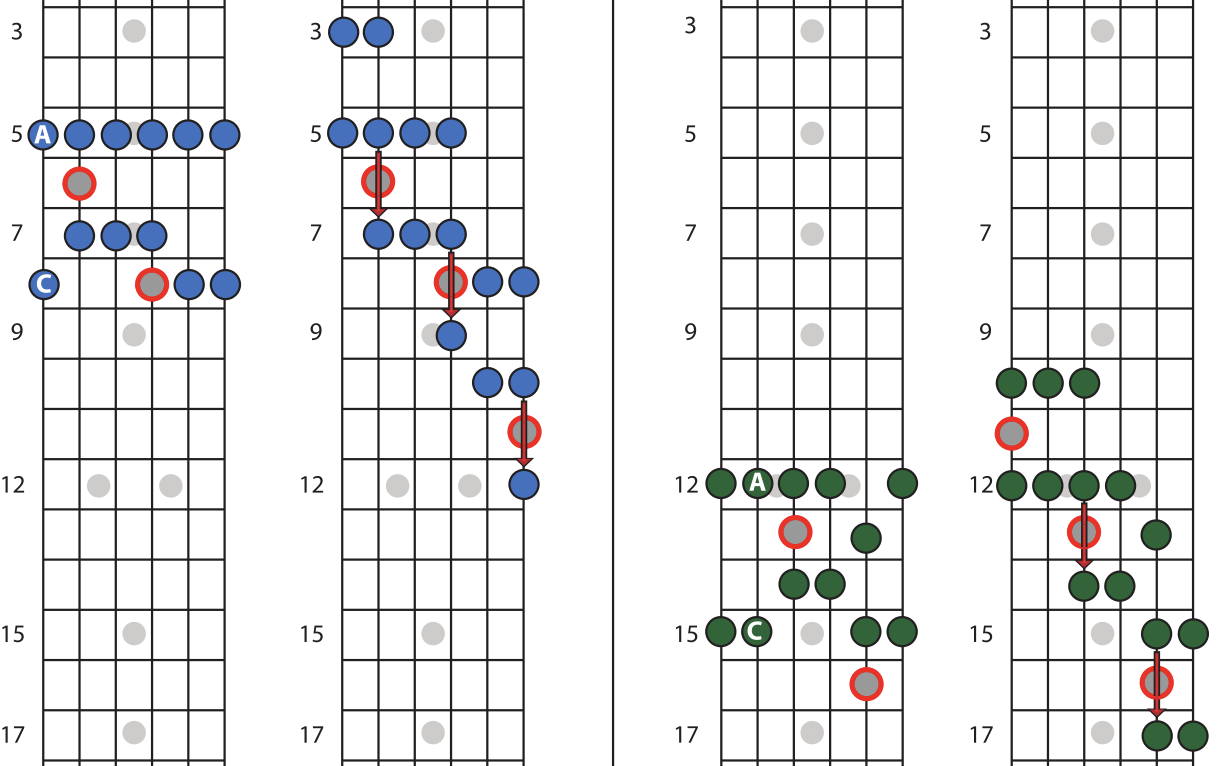
Click image above to download PDF
I'll be honest: I sometimes have to remind myself to not play this note. I can't tell you how many times I've had to reshoot a demonstration video because I reflexively added the blues note into something I was teaching strictly as pentatonic. At this point the two scales feel like one scale to me. That's where I want you to get.
A lot of players learn the blues scale and then just... don't use it. If that's you, consider this your gentle reminder.
If you want to see this in action, I've got a YouTube video that walks through exactly what I'm describing — I'll link it below.
Link to YouTube Blues Scale video
Happy practicing, Dustin
P.S. The Landmark Pentatonic System — including how the blues scale fits into it — is a core part of my Essential Skills for Guitar course. If you want to go deeper, take a look.