PRESENCE - Volume 75
Inspiration For Guitarists
There are so many topics in guitar education that are taught in an overcomplicated way. Modes are definitely one of those topics. They came up in my Office Hours Group session a couple of weeks ago and sparked one of the best discussions we've had.
You've probably heard of the 80/20 principle. It’s the idea that 80% of your results come from 20% of your efforts. I see it talked about everywhere: business, fitness, productivity. It has become a bit of a cliche (especially in the age of AI). I almost hate to use it but it is absolutely true in music.
I think there is about 20% of music theory that is crucial to know (the Number System, the CAGED System, and the Pentatonic Scale). Just those 3 skills will give you at least 80% of what is going on in your favorite songs. The players who improve fastest are the ones who identify that 20% and lean into it hard. Everything else is noise.
And that’s the problem with a lot of YouTube content. It puts too much focus on the 80% of theory that only gives you 20% of the results. It's like most YouTube content gets it backwards.
So here's what that actually looks like with modes.
There are 6 modes that get used in real music — 3 major modes and 3 minor modes. Every single one of them contains the pentatonic scale at its core. That means the pentatonic gives you 5 of the 7 possible notes in any mode.
That's 71% of the sound. No theory required.
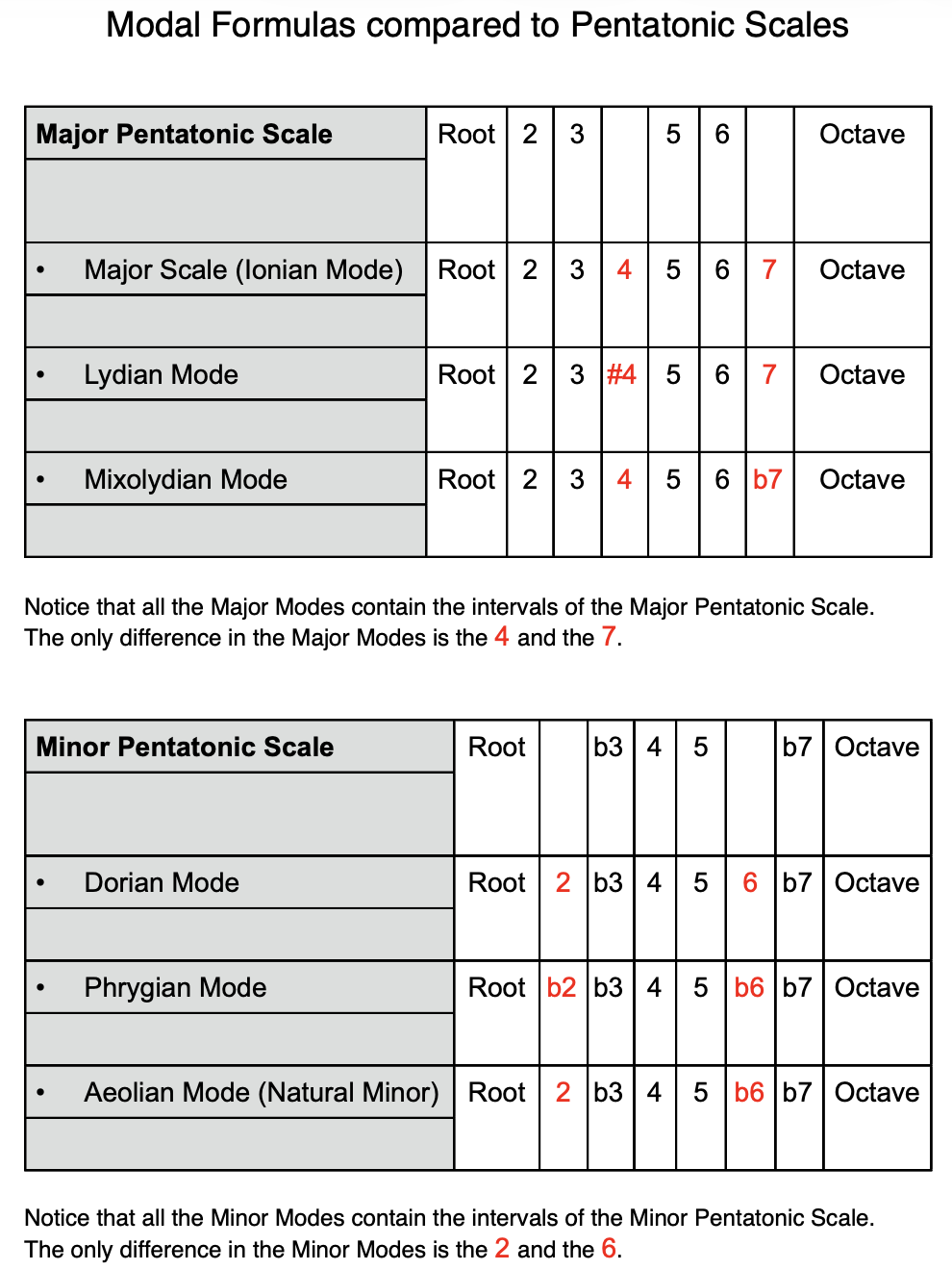
Click Image to Download PDF
Technically, determining which mode a song is in requires analyzing the chord progression. But here's the shortcut most players never get told: in the majority of songs, all you need to know is whether the main chord is Major or Minor. Play that pentatonic and you're already inside the mode, just without the 2 notes that vary from mode to mode.
If you want to go a little deeper, here's where it gets interesting.
The two most commonly used major modes by far — Ionian and Mixolydian — both contain the 4. Add the 4 to your Major Pentatonic and you have the Major Hexatonic Scale. A favorite of the Allman Brothers and you can hear it all over their playing.
The same idea works on the minor side. Dorian and Aeolian — the two most used minor modes by far — both contain the 2. Add the 2 to your Minor Pentatonic and you have the Minor Hexatonic Scale. David Gilmour, Joe Bonamassa, Pat Metheny, countless others live here.
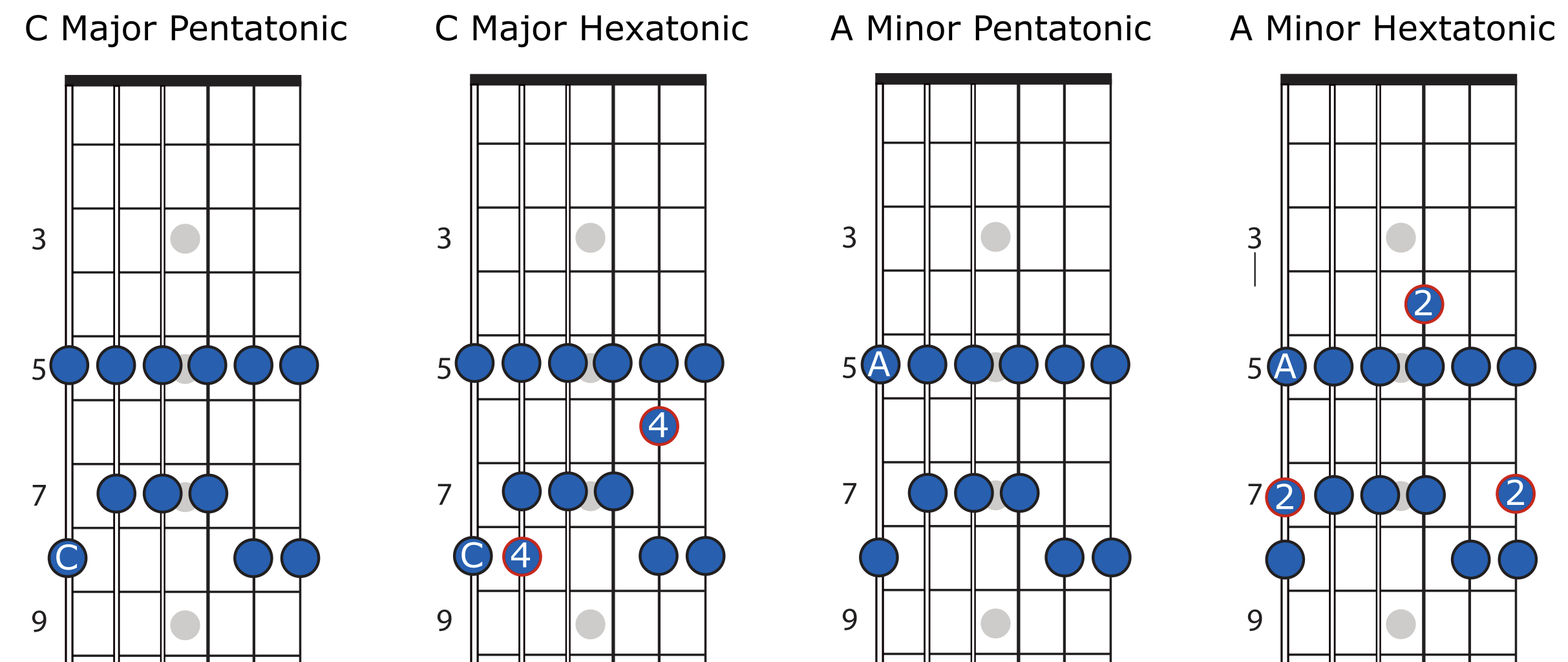
Click Image To Download
71% of the sound with the pentatonic.
86% with one added note — major or minor.
All without cracking open a modes book.
This is what the 20% looks like. You don't need all seven modes. You need to know whether you're in a major or minor situation, trust your pentatonic foundation, and use your ear to find the extra notes when you need them.
If you want to be in the room for conversations like this — where we take concepts and apply them to real songs and real playing situations — Office Hours might be exactly what you're looking for.
Learn more about Office Hours here
- Dustin
P.S. The 7th mode — Locrian (the diminished one) — pretty much never gets used. So don't worry about it.
P.S. — The Essential Skills Course covers the Number System, the Landmark Pentatonic System, and the CAGED System — the three frameworks I've used for 40 years to learn songs, navigate the fretboard, and actually understand what I'm playing. If that sounds like what you've been missing, the link above will tell you everything.