PRESENCE - Volume 77
Inspiration For Guitarists
Guitarists tend to lean into the same handful of keys. This isn’t by accident, it’s because of the design of the instrument. And once you see why, you'll know exactly where to spend your practice time.
Here's the short version: your open strings — E A D G B E — are an important asset to guitarists. They let you play big, ringing chords instead of barre chords. They're the backbone of riffs like Heartbreaker, Pride and Joy, and Enter Sandman. It's hard to name a classic guitar riff that doesn't lean on an open string somewhere.
So naturally, we gravitate toward keys that let us use as many of those open strings as possible.
Start with C. Every open string on the guitar belongs to the C Major scale, so all six are fair game for chords and melody. Move up the circle of fifths to G — same story, all six open strings available. That's why C (and its relative minor, A minor) and G (and its relative minor, E minor) are, by a wide margin, the most guitar-friendly keys that exist. Mostly open chords, full access to open strings.
Next is D. Still all open strings available — but its relative minor, B minor, is a barre chord, so it's a notch less popular, though still a heavy hitter.
Keep climbing and the open strings start disappearing. A Major introduces a G#, so you lose the open G string — more barre chords creep in. E Major loses the D and G strings too, though the 1 and 4 chords are still nice and open, which keeps it in regular rotation.
Go the other direction around the circle and you hit the wall even faster — F Major loses the B string almost immediately, though its relative minor (D minor) still shows up in some classic tunes.
Beyond these six keys, things drop off fast. Once you're out of open strings, you're in barre-chord territory almost entirely — and it shows. There are dozens and dozens of guitar-driven songs in the key of G. Try naming one in G♭. It's not that those keys sound bad, it's just that guitarists don't naturally write and play in them, because the instrument itself is pushing you elsewhere.
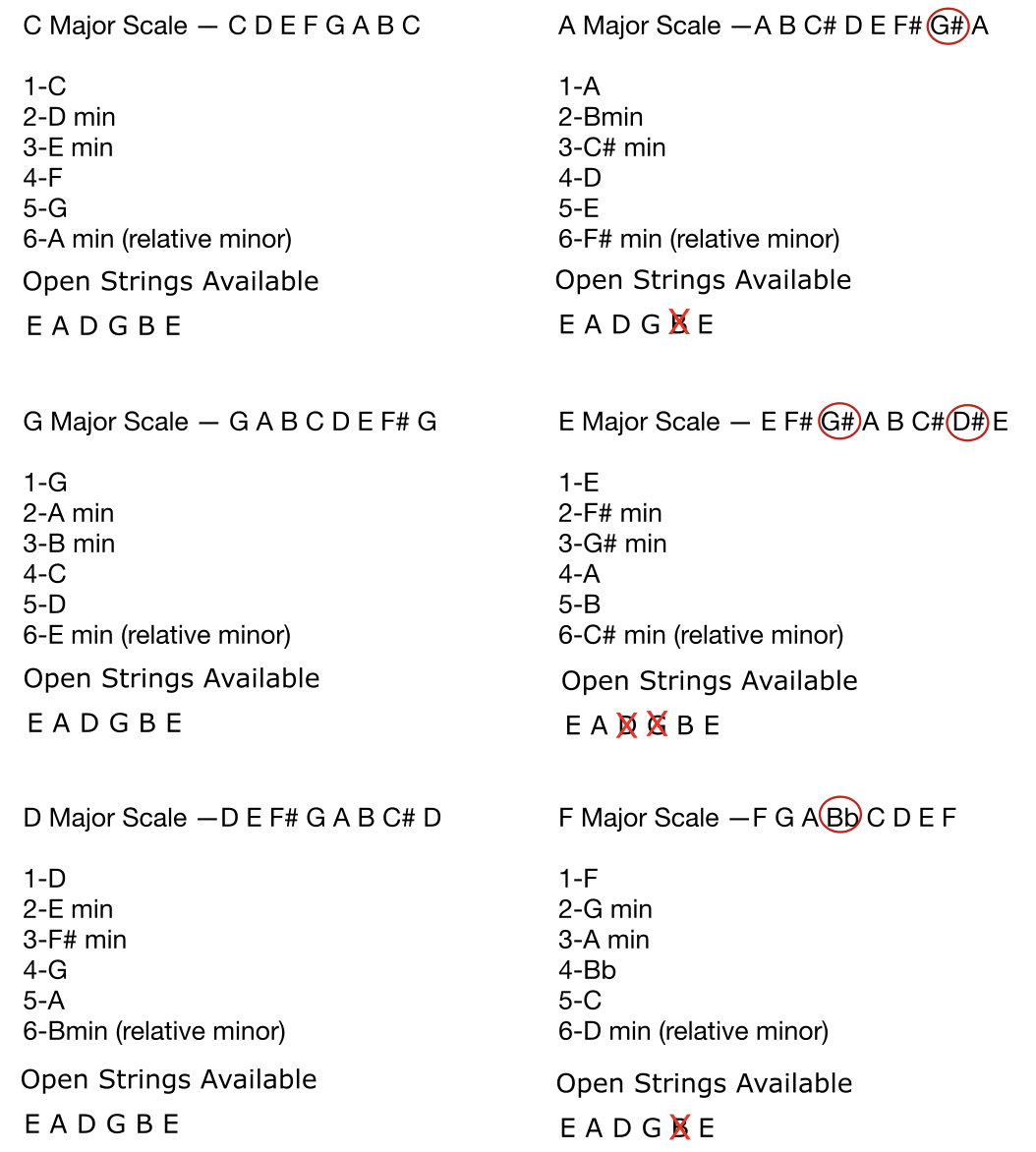
Click Image Above to Download PDF
The takeaway: don't treat all 12 keys as equally worth your time. Start with C and its relative A minor, then G and its relative E minor. Learn the chords in each using the Number System, then go back through songs you already play and notice how many of them live in one of those two keys.
Next week I'll hand you a running list of songs organized by key, so you can put this to work immediately.
-Dustin
P.S. This is exactly the kind of foundation we build inside the Essential Skills Course — the Number System, CAGED, and Landmark Pentatonic, all mapped to real songs you already want to play.