PRESENCE - Volume 87
Inspiration For Guitarists
I had the honor of a brief conversation with B.B. King before he passed. It was at his club in Memphis.
B.B. didn't play his own club very often. He played all over the world, averaging 200 to 300 shows a year for decades, and even into his 70s and 80s he was still playing well over 100 shows a year. There's a reason they called him the King of the Blues.
I was lucky. A former student of mine somehow lined up tickets to this rare event and took me along.
The show was great. He had a top-notch band, and hearing that beautiful, clear tone in a small club was fantastic. (I REALLY love being able to hear the sound coming off the stage instead of through giant PA speakers a football field away.)
After the show, we got to go backstage and meet the legend. Not surprisingly, he was friendly and easy to talk to. I told him it was an honor to meet him, that I taught guitar, and that "The Thrill Is Gone" was a song I often taught my students.
"Maybe I should take some lessons with you," he joked.
"I can't teach you anything you don't already know," I said.
"Well, maybe I should just buy you an apple," he said with a warm smile.
It's an interaction I'll always remember.
The B.B. King Shape
There's a shape blues guitarists rely on that's commonly called the "B.B. King shape," for obvious reasons. If you've listened to any B.B. King record, or any of the countless guitarists he influenced, you've heard it.
It's a very finger-friendly spot where the major and minor pentatonic scales overlap.
Here's why that works. Blues is built on dominant 7th chords, which are major chords with a minor 7th added. In non-theory talk, blues is kind of major and kind of minor at the same time. That's why you can use BOTH major and minor pentatonic over a blues.
Blues really blurs some of the music theory rules.
The B.B. King shape is small but powerful. He mostly stuck to the top three strings (G, B, and E).
The root note is on the B string, and that's the "money note." When I play this shape, my index finger stays anchored on that note, and it's where most of my phrases end.
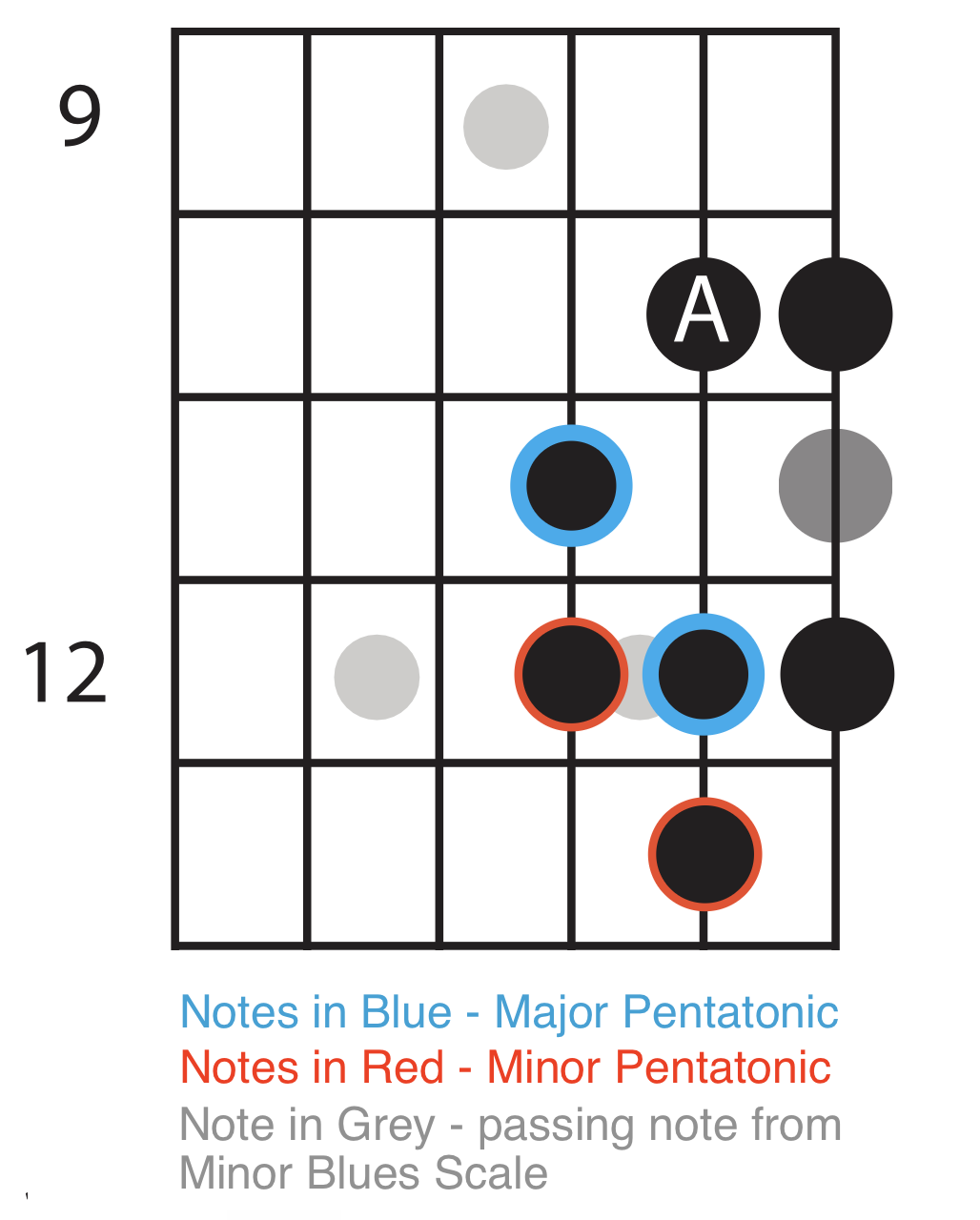
Click Diagram to Download PDF
The B string is also magical for bends. With my index on the root:
My ring finger plays the 2nd. I can bend it a half step (to the ♭3), a whole step (to the 3rd), or even a step and a half (to the 4th).
My pinky plays the ♭3. I can bend it a half step (to the 3rd), a whole step (to the 4th), or a step and a half (to the ♭5, the "blue note").
The bottom line: you can't really go wrong bending on this string. It's expressive and forgiving, and you don't have to bend perfectly in tune for it to sound good.
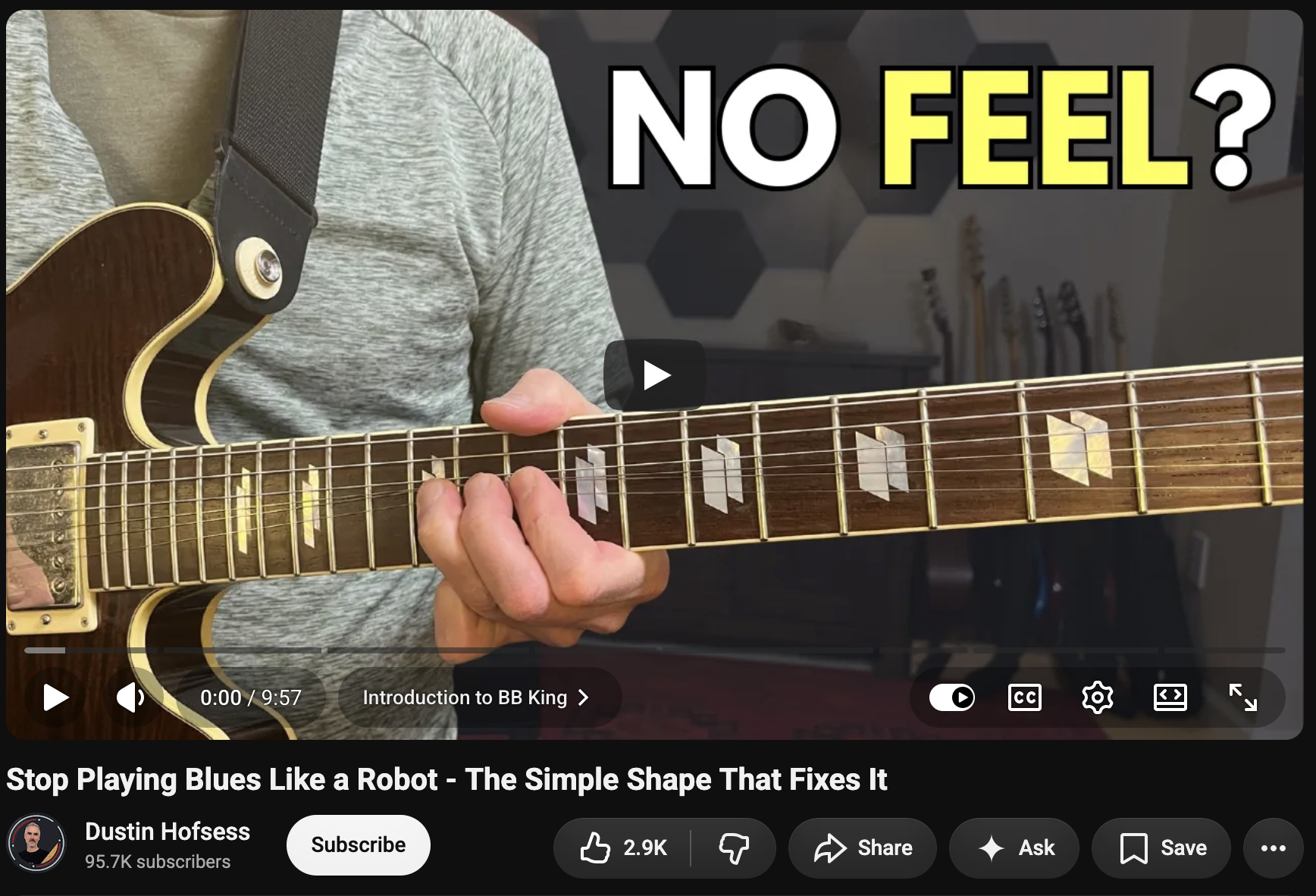
https://www.youtube.com/watch?v=wOI02omu5j4&feature=youtu.be
This week, try this shape out with some blues backing tracks and start by ending every phrase on that B-string root. You’ll see how much blues you can squeeze out of just three strings.
-Dustin
P.S. Want to get comfortable blending major and minor pentatonic like B.B. did? The Essential Skills Guitar Course walks you through it with my Landmark Pentatonic System, plus backing tracks to practice those bends over.